All work

CarMax Auctions · B2B registration

Dealer Registration: Getting dealers to wholesale inventory faster

A redesign that got dealers from sign-up to wholesale inventory faster, inside a legacy codebase we couldn’t rebuild.

Role
Senior Product Designer
Team
PM, 3 engineers
Timeline
Feb. 2026, launched before May 2026
Platform
Responsive web, B2B (CarMax Auctions)
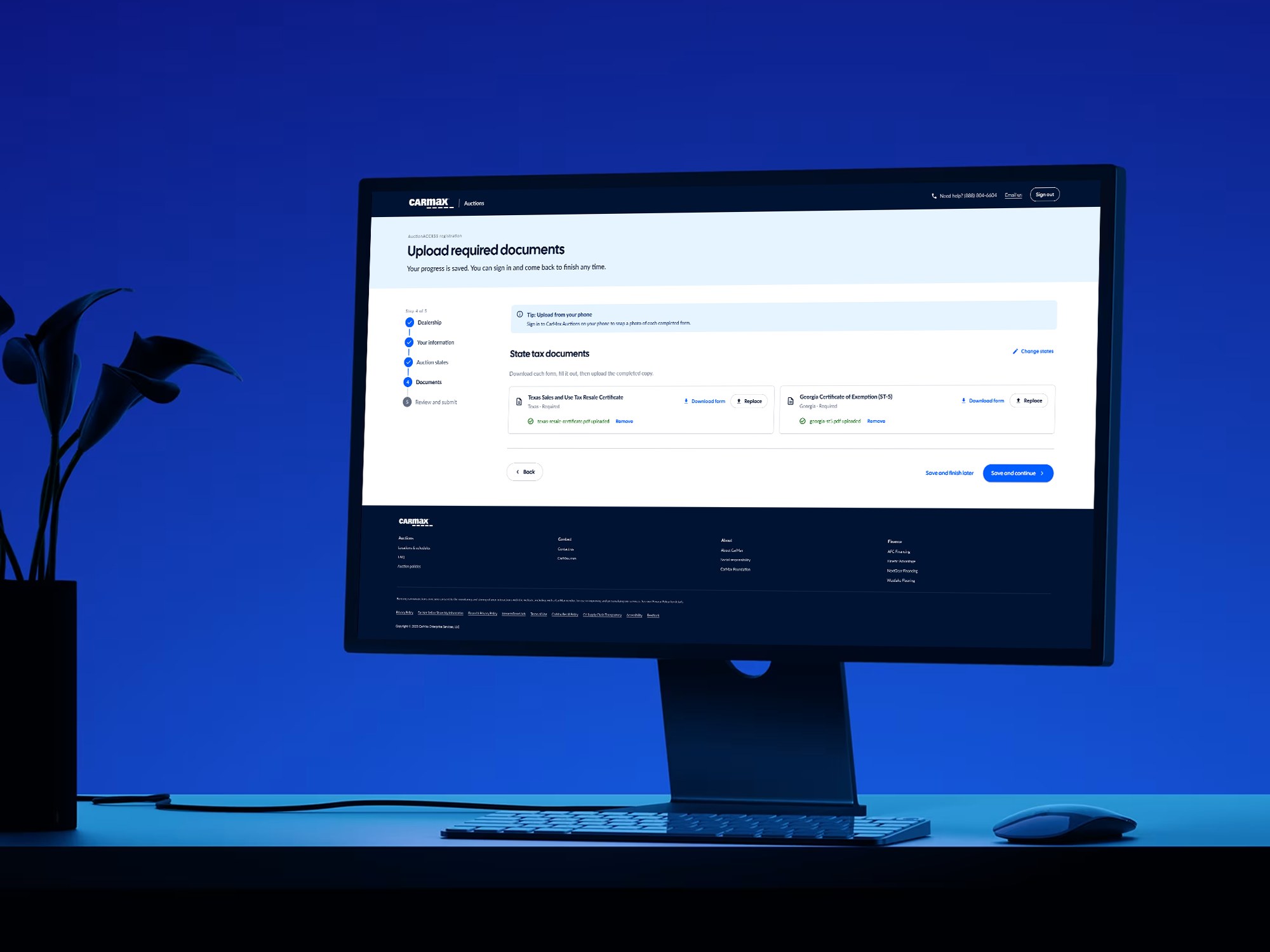
The redesigned CarMax Auctions registration flow on a desktop monitor: the Upload required documents step, with both state tax documents uploaded.

The short version

Problem

Registering a dealership for CarMax Auctions took dealers anywhere from 4 to 45 minutes. Until registration was approved, they couldn’t preview the wholesale cars they came to buy.

What I did

Redesigned the registration flow to reuse what AuctionACCESS already knew about the dealer, rebuilt document upload and delete, and added clear error and recovery states, all scoped to what the legacy codebase could absorb.

Result

New dealer registrations grew 22% from May to August 2026 compared with the same months in 2025, from about 1,400 to 1,708.

  • +22%New dealer registrations, May to Aug. 2026 vs. 2025
  • ~1,708New registrations, up from ~1,400
  • 66%Rated registration easy or very easy (n=35)

01 · Context

Every new registration is a new buyer.

Registration is the front door to CarMax Auctions: a dealer can’t preview, save or bid on wholesale cars until their dealership is approved. Every new registration is a new buyer, so every minute lost in the flow delays revenue and the dealer’s first look at inventory.

Dealers prove who they are through AuctionACCESS, the industry credential for wholesale auto auctions. They then add personal and business details, choose the states they buy in, and upload each state’s tax documents.

The legacy flow ran on an older codebase that was slow and risky to change. Any redesign had to fit inside it.

73%Of CarMax Auctions dealers use the site on desktop
7 stepsPlus sign-in and account creation in the legacy flow

02 · The problem, reframed

Registration wasn’t slow because it was long. It asked dealers to re-prove what we already knew.

Then it left them unsure whether their proof had landed.

SignalWhat we sawSource
4 to 45 minTime to complete one registrationFullStory, 33 users, Jan. to Mar. 2026
7 steps + accountBegin, Account, Personal, Business, States, Documents, Submit, after a separate sign-in and account creationLegacy flow audit
5 sections re-typedName, date of birth, SSN, home address and phone, all entered by hand right after linking AuctionACCESSLegacy “About You” screen
Conflicting statusAn uploaded document showed a green check next to red “This document is required” textLegacy “Required Documents” screen
Hidden blockersDealerships listed as “Dealership 1 - Buyer” with no address or ID; one line said some “may be unavailable” without saying which or whyLegacy “Dealership selection” screen

Three themes, each costing time in a different way

  1. 1

    Re-entry

    Typing data that AuctionACCESS already held added minutes and typos.

  2. 2

    Ambiguous status

    Dealers couldn’t tell if an upload worked, so they re-uploaded, called support, or stopped.

  3. 3

    Hidden blockers

    Dealers found out a dealership or document was a problem only after trying to continue.

03 · My role

I owned the flow end to end, inside what engineering could ship.

I owned

  • End-to-end flow for new dealer registration, from linking AuctionACCESS to submission
  • The document upload and delete experience, including every file state
  • Error, empty and recovery states, including the return-for-corrections flow
  • UX copy for steps, errors and confirmations
  • Usability testing to validate the design direction

I influenced

  • Negotiated with the dev lead to ship read-only AuctionACCESS data instead of editable fields, which needed no write-back and fit the sprint
  • Got engineering to show upload progress and allow Cancel, so dealers could see a file was still sending
  • Convinced the PM to prioritize document upload and delete, because that’s where dealers stalled

04 · Constraints and success criteria

Ship it inside the legacy codebase, in 3 months.

Constraints

  • Legacy codebase. Older stack, hard to edit, with limited room for new components or layouts.
  • Time and engineering lift. 3 months, 3 engineers.
  • Compliance. State tax documents, SSN or FEIN, and the dealer agreement were required and couldn’t be cut.
  • AuctionACCESS as the source of truth. Personal and dealership records live there, so CarMax could read them but not edit them.

Success criteria

TypeMetricTarget
PrimaryNew dealer registrations completedIncrease 10%
SecondaryTime to complete a registrationUnder 5 minutes
GuardrailApplications returned for corrections, or rejectedNo increase

05 · Key decisions

Remove work dealers shouldn’t have to do.

  1. 1

    Show AuctionACCESS data as read-only instead of asking for it again

    Options

    • Keep the full manual form (no lift)
    • Prefill editable fields (needs sync and write-back)
    • Show read-only data with a link to update it in AuctionACCESS (chosen)

    Why this one

    Removes most typing, keeps one source of truth, and needs no write-back to AuctionACCESS, which the legacy stack couldn’t easily support.

    What we gave up

    Dealers can’t fix a typo inline; they have to leave and update it in AuctionACCESS.

  2. 2

    Give every document its own row with explicit states

    Options

    • Patch the copy on the existing page
    • Add bulk or drag-and-drop upload
    • One row per required document with download, upload, uploading, uploaded and error states, plus an inline remove (chosen)

    Why this one

    Status was the main source of confusion. A row per document answers “what’s left, and did it work?” at a glance, and fits the legacy page structure.

    What we gave up

    Bulk upload and drag-and-drop, because of the engineering lift.

  3. 3

    Pushing back: keep errors inside the flow

    What was proposed

    Sending registration error notifications to dealers by email or phone.

    What I pushed for

    Keep the registration experience streamlined. Every affected dealer is told what to fix at the end of the flow, on the return-for-corrections page.

06 · The solution

Five steps after AuctionACCESS, each fix mapped to a theme.

The shipped flow cut the legacy process to 5 steps after linking AuctionACCESS, and every change maps to one of the three problem themes. Numbers match the callouts on the before and after screens.

#StepLegacyShippedTheme
1Sign inWelcome screen, then a separate “Create an account” formOne screen asks for the AuctionACCESS number and the last 4 characters of a photo ID, with a sign-up link for dealers without an accountRe-entry
2Progress7-step bar across the top, with a car icon for the current stepVertical 5-step stepper beside the content, with checks on finished stepsAmbiguous status
3Dealership selectionCheckbox list of “Dealership 1 - Buyer” with no address or IDSelector tiles with name, role, address and AuctionACCESS ID, and an alert when none is selectedHidden blockers
4Unavailable dealershipsOne line: “Some dealership may be unavailable to add until a later date”A separate “Other dealerships” group with the reason on each tileHidden blockers
5Your informationTwo screens of manual fields for personal and business detailsOne screen: AuctionACCESS data shown read-only, asking only for what’s missing (SSN, phone, title, dealership and business type, tax IDs, export)Re-entry
6ErrorsHighlighted the field that needed attention but gave no contextError summary at the top of the page listing every field to fixAmbiguous status
7StatesBulleted list of states to attend auctions inGrid of auction states, with a note that each state adds its own documentsHidden blockers
8Documents“Upload Files” buttons, large file icons, “Delete File”, and “required” text that stayed red after uploadPer-document rows: download form, upload, uploading, uploaded chip with remove, and a missing-upload errorAmbiguous status
9Review and submitOne long review page, with low contrast that made messages hard to readGrouped sections with Edit buttons, plus the legal disclosures and an acknowledgmentAmbiguous status
10After submitMember dashboardConfirmation with the 1 to 2 business day timeline and a link to start browsing inventoryPreview cars sooner
Legacy and shipped Dealer Registration screens side by side in 10 numbered rows: 1 sign in, 2 progress, 3 dealership selection, 4 unavailable dealerships, 5 your information, 6 errors, 7 states, 8 documents, 9 review and submit, and 10 after submit.
Legacy vs. shipped, with callouts 1 to 10

07 · Validation

What testing changed, and what launch revealed.

  • Usability sessions with dealers

    Ran 5 remote sessions with dealership owners on a clickable prototype. 3 of 5 missed that an upload had finished, so we added the uploaded chip and the Remove action.

  • Post-launch survey

    In September 2026, 35 dealers who registered on the new flow answered a survey. The document step held up (75% uploaded without issues), but 25% of the dealers who reached it saw an error, and removing or replacing a document on a phone was the weakest point. Those findings set the priorities for the next iteration.

08 · Outcomes

Registrations up 22% year over year.

New registrations grew 22% year over year after launch. A September 2026 survey of 35 dealers shows most found the new flow easy, and that document upload, the main target of the redesign, worked for 3 in 4 dealers.

MetricResultBaselineWindowAttribution
New dealer registrations+22% (~1,708)~1,400 (May to Aug. 2025)May to Aug. 2026 vs. 2025Same months year over year, so seasonality is controlled; no known marketing changes
Time to complete a registrationNot measured after launch (target: under 5 min)4 to 45 minNot trackedFullStory baseline, 33 users, Jan. to Mar. 2026; see Reflection
Rated registration easy or very easy66% (26% neutral, 9% difficult)No pre-launch surveySep. 2026Post-registration survey, n=35
Uploaded documents without issues75% (8% took multiple tries, 17% didn’t attempt)No pre-launch surveySep. 2026Post-registration survey, n=24
Very confident removing a document56% (22% somewhat, 22% not confident)No pre-launch surveySep. 2026Post-registration survey, n=18
Saw an error during the document step25%; of those, 67% said next steps were very clearNo pre-launch surveySep. 2026Post-registration survey, n=24 and n=6

Source: Dealer Connect Post Modern Registration Survey, September 2026. Each question went only to dealers who reached that step, so sample sizes vary. The survey has no pre-launch baseline, so these numbers describe the new flow rather than prove the improvement.

What the survey says to fix next

Removing or replacing a document is the weak spot: 22% of dealers weren’t confident doing it, and the layout is harder to use on phones. Error messages also need consistent next steps, since 1 of the 6 dealers who saw one found it not at all clear. These findings fed the next iteration.

“The layout of the upload and download buttons… were easier to identify on the PC HTML page than the phone HTML page.”Dealer, rated overall ease as Neutral

09 · Reflection

What I’d do differently.

  • What I’d do differently

    I’d instrument time to complete and step drop-off before launch, so the 22% could be tied to specific changes instead of the flow as a whole.

  • The principle I carried forward

    In a constrained codebase, the biggest wins come from removing work the user shouldn’t have to do, not from adding new UI. Reusing AuctionACCESS data and making every document’s status obvious cost little to build and saved dealers the most time.

Have a problem like this? I’m open to senior product design roles. Reach out by email or LinkedIn.
Email me
Next case study Kain & Train A macro tracker, designed with Claude, that logs the dish instead of the ingredients. Work in progress.
All work

CarMax Auctions · B2B registration

Dealer Registration: Getting dealers to wholesale inventory faster

A redesign that got dealers from sign-up to wholesale inventory faster, inside a legacy codebase we couldn’t rebuild.

Role
Senior Product Designer
Team
PM, 3 engineers
Timeline
Feb. 2026, launched before May 2026
Platform
Responsive web, B2B (CarMax Auctions)
The redesigned CarMax Auctions registration flow on a desktop monitor: the Upload required documents step, with both state tax documents uploaded.

The short version

Problem

Registering a dealership for CarMax Auctions took dealers anywhere from 4 to 45 minutes. Until registration was approved, they couldn’t preview the wholesale cars they came to buy.

What I did

Redesigned the registration flow to reuse what AuctionACCESS already knew about the dealer, rebuilt document upload and delete, and added clear error and recovery states, all scoped to what the legacy codebase could absorb.

Result

New dealer registrations grew 22% from May to August 2026 compared with the same months in 2025, from about 1,400 to 1,708.

  • +22%New dealer registrations, May to Aug. 2026 vs. 2025
  • ~1,708New registrations, up from ~1,400
  • 66%Rated registration easy or very easy (n=35)

01 · Context

Every new registration is a new buyer.

Registration is the front door to CarMax Auctions: a dealer can’t preview, save or bid on wholesale cars until their dealership is approved. Every new registration is a new buyer, so every minute lost in the flow delays revenue and the dealer’s first look at inventory.

Dealers prove who they are through AuctionACCESS, the industry credential for wholesale auto auctions. They then add personal and business details, choose the states they buy in, and upload each state’s tax documents.

The legacy flow ran on an older codebase that was slow and risky to change. Any redesign had to fit inside it.

73%Of CarMax Auctions dealers use the site on desktop
7 stepsPlus sign-in and account creation in the legacy flow

02 · The problem, reframed

Registration wasn’t slow because it was long. It asked dealers to re-prove what we already knew.

Then it left them unsure whether their proof had landed.

  • 4 to 45 minTime to complete one registrationSource: FullStory, 33 users, Jan. to Mar. 2026
  • 7 steps + accountBegin, Account, Personal, Business, States, Documents, Submit, after a separate sign-in and account creationSource: Legacy flow audit
  • 5 sections re-typedName, date of birth, SSN, home address and phone, all entered by hand right after linking AuctionACCESSSource: Legacy “About You” screen
  • Conflicting statusAn uploaded document showed a green check next to red “This document is required” textSource: Legacy “Required Documents” screen
  • Hidden blockersDealerships listed as “Dealership 1 - Buyer” with no address or ID; one line said some “may be unavailable” without saying which or whySource: Legacy “Dealership selection” screen

Three themes, each costing time in a different way

1

Re-entry

Typing data that AuctionACCESS already held added minutes and typos.

2

Ambiguous status

Dealers couldn’t tell if an upload worked, so they re-uploaded, called support, or stopped.

3

Hidden blockers

Dealers found out a dealership or document was a problem only after trying to continue.

03 · My role

I owned the flow end to end, inside what engineering could ship.

I owned

  • End-to-end flow for new dealer registration, from linking AuctionACCESS to submission
  • The document upload and delete experience, including every file state
  • Error, empty and recovery states, including the return-for-corrections flow
  • UX copy for steps, errors and confirmations
  • Usability testing to validate the design direction

I influenced

  • Negotiated with the dev lead to ship read-only AuctionACCESS data instead of editable fields, which needed no write-back and fit the sprint
  • Got engineering to show upload progress and allow Cancel, so dealers could see a file was still sending
  • Convinced the PM to prioritize document upload and delete, because that’s where dealers stalled

04 · Constraints and success criteria

Ship it inside the legacy codebase, in 3 months.

Constraints

  • Legacy codebase. Older stack, hard to edit, with limited room for new components or layouts.
  • Time and engineering lift. 3 months, 3 engineers.
  • Compliance. State tax documents, SSN or FEIN, and the dealer agreement were required and couldn’t be cut.
  • AuctionACCESS as the source of truth. Personal and dealership records live there, so CarMax could read them but not edit them.

Success criteria

  • PrimaryNew dealer registrations completedTarget: Increase 10%
  • SecondaryTime to complete a registrationTarget: Under 5 minutes
  • GuardrailApplications returned for corrections, or rejectedTarget: No increase

05 · Key decisions

Remove work dealers shouldn’t have to do.

  1. 1

    Show AuctionACCESS data as read-only instead of asking for it again

    Options

    • Keep the full manual form (no lift)
    • Prefill editable fields (needs sync and write-back)
    • Show read-only data with a link to update it in AuctionACCESS (chosen)

    Why this one

    Removes most typing, keeps one source of truth, and needs no write-back to AuctionACCESS, which the legacy stack couldn’t easily support.

    What we gave up

    Dealers can’t fix a typo inline; they have to leave and update it in AuctionACCESS.

  2. 2

    Give every document its own row with explicit states

    Options

    • Patch the copy on the existing page
    • Add bulk or drag-and-drop upload
    • One row per required document with download, upload, uploading, uploaded and error states, plus an inline remove (chosen)

    Why this one

    Status was the main source of confusion. A row per document answers “what’s left, and did it work?” at a glance, and fits the legacy page structure.

    What we gave up

    Bulk upload and drag-and-drop, because of the engineering lift.

  3. 3

    Pushing back: keep errors inside the flow

    What was proposed

    Sending registration error notifications to dealers by email or phone.

    What I pushed for

    Keep the registration experience streamlined. Every affected dealer is told what to fix at the end of the flow, on the return-for-corrections page.

06 · The solution

Five steps after AuctionACCESS, each fix mapped to a theme.

The shipped flow cut the legacy process to 5 steps after linking AuctionACCESS, and every change maps to one of the three problem themes. Numbers match the callouts on the before and after screens.

  1. 1Sign in
    Legacy: Welcome screen, then a separate “Create an account” formShipped: One screen asks for the AuctionACCESS number and the last 4 characters of a photo ID, with a sign-up link for dealers without an accountRe-entry
  2. 2Progress
    Legacy: 7-step bar across the top, with a car icon for the current stepShipped: Vertical 5-step stepper beside the content, with checks on finished stepsAmbiguous status
  3. 3Dealership selection
    Legacy: Checkbox list of “Dealership 1 - Buyer” with no address or IDShipped: Selector tiles with name, role, address and AuctionACCESS ID, and an alert when none is selectedHidden blockers
  4. 4Unavailable dealerships
    Legacy: One line: “Some dealership may be unavailable to add until a later date”Shipped: A separate “Other dealerships” group with the reason on each tileHidden blockers
  5. 5Your information
    Legacy: Two screens of manual fields for personal and business detailsShipped: One screen: AuctionACCESS data shown read-only, asking only for what’s missing (SSN, phone, title, dealership and business type, tax IDs, export)Re-entry
  6. 6Errors
    Legacy: Highlighted the field that needed attention but gave no contextShipped: Error summary at the top of the page listing every field to fixAmbiguous status
  7. 7States
    Legacy: Bulleted list of states to attend auctions inShipped: Grid of auction states, with a note that each state adds its own documentsHidden blockers
  8. 8Documents
    Legacy: “Upload Files” buttons, large file icons, “Delete File”, and “required” text that stayed red after uploadShipped: Per-document rows: download form, upload, uploading, uploaded chip with remove, and a missing-upload errorAmbiguous status
  9. 9Review and submit
    Legacy: One long review page, with low contrast that made messages hard to readShipped: Grouped sections with Edit buttons, plus the legal disclosures and an acknowledgmentAmbiguous status
  10. 10After submit
    Legacy: Member dashboardShipped: Confirmation with the 1 to 2 business day timeline and a link to start browsing inventoryPreview cars sooner
Legacy vs. shipped, with callouts 1 to 10

07 · Validation

What testing changed, and what launch revealed.

Usability sessions with dealers

Ran 5 remote sessions with dealership owners on a clickable prototype. 3 of 5 missed that an upload had finished, so we added the uploaded chip and the Remove action.

Post-launch survey

In September 2026, 35 dealers who registered on the new flow answered a survey. The document step held up (75% uploaded without issues), but 25% of the dealers who reached it saw an error, and removing or replacing a document on a phone was the weakest point. Those findings set the priorities for the next iteration.

08 · Outcomes

Registrations up 22% year over year.

New registrations grew 22% year over year after launch. A September 2026 survey of 35 dealers shows most found the new flow easy, and that document upload, the main target of the redesign, worked for 3 in 4 dealers.

  • New dealer registrations+22% (~1,708)Baseline: ~1,400 (May to Aug. 2025) · May to Aug. 2026 vs. 2025Same months year over year, so seasonality is controlled; no known marketing changes
  • Time to complete a registrationNot measured after launch (target: under 5 min)Baseline: 4 to 45 min · Not trackedFullStory baseline, 33 users, Jan. to Mar. 2026; see Reflection
  • Rated registration easy or very easy66% (26% neutral, 9% difficult)Baseline: No pre-launch survey · Sep. 2026Post-registration survey, n=35
  • Uploaded documents without issues75% (8% took multiple tries, 17% didn’t attempt)Baseline: No pre-launch survey · Sep. 2026Post-registration survey, n=24
  • Very confident removing a document56% (22% somewhat, 22% not confident)Baseline: No pre-launch survey · Sep. 2026Post-registration survey, n=18
  • Saw an error during the document step25%; of those, 67% said next steps were very clearBaseline: No pre-launch survey · Sep. 2026Post-registration survey, n=24 and n=6

Source: Dealer Connect Post Modern Registration Survey, September 2026. Each question went only to dealers who reached that step, so sample sizes vary. The survey has no pre-launch baseline, so these numbers describe the new flow rather than prove the improvement.

What the survey says to fix next

Removing or replacing a document is the weak spot: 22% of dealers weren’t confident doing it, and the layout is harder to use on phones. Error messages also need consistent next steps, since 1 of the 6 dealers who saw one found it not at all clear. These findings fed the next iteration.

“The layout of the upload and download buttons… were easier to identify on the PC HTML page than the phone HTML page.”Dealer, rated overall ease as Neutral

09 · Reflection

What I’d do differently.

What I’d do differently

I’d instrument time to complete and step drop-off before launch, so the 22% could be tied to specific changes instead of the flow as a whole.

The principle I carried forward

In a constrained codebase, the biggest wins come from removing work the user shouldn’t have to do, not from adding new UI. Reusing AuctionACCESS data and making every document’s status obvious cost little to build and saved dealers the most time.

Have a problem like this? I’m open to senior product design roles. Reach out by email or LinkedIn.
Email me
Next case study Kain & Train A macro tracker, designed with Claude, that logs the dish instead of the ingredients. Work in progress.