All work

CarMax Auctions · B2B workflow

Vehicle Preview Enhancements

Restructuring how dealers move through vehicle photos, so inspecting damage stops interrupting the evaluation it exists to support.

Role
Senior Product Designer, Design Lead, UX Researcher
Team
1 PM, 3 Engineers
Timeline
About 6 months, 2024
Platform
Desktop web, dealer actions tooling
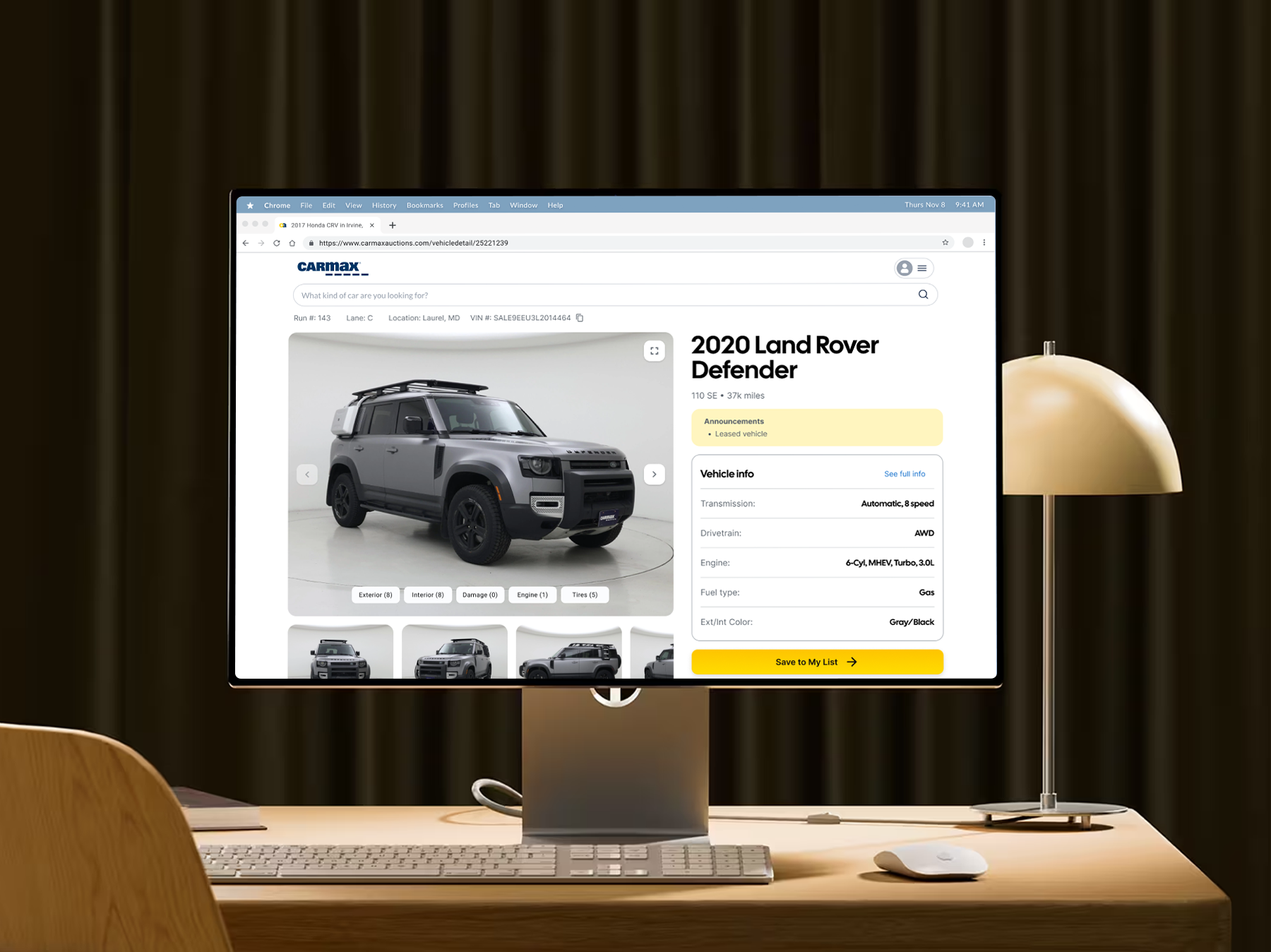
The redesigned CarMax Auctions vehicle preview page on a desktop monitor, showing a 2020 Land Rover Defender with photo group tabs and thumbnails

The short version

Problem

Dealers clicked through 15 to 20 photos in a row and repeatedly opened and closed an enlarged view to check one vehicle for damage.

What I did

Led research, reframed the problem around keeping dealers in place during inspection, and redesigned the preview so thumbnails and zoom on hover replace the open, close and resume loop.

Result

Measurable lifts in engagement, dealer confidence and time spent per vehicle. Definitions and baselines are in Outcomes.

  • +16%Pre-auction engagement: more vehicles saved and more notes created before auction day
  • +25%Dealer confidence in photo quality and likelihood to bid, via dealer survey
  • 50%Less time per vehicle for average dealers

01 · Context

Vehicle preview is where a dealer decides to bid.

CarMax Auctions is CarMax’s wholesale business, where licensed dealers browse and evaluate inventory before bidding. The preview page is where most of that evaluation happens, especially for exterior condition and damage.

Business stakes
20,000–25,000 active dealers and 10,300+ auction vehicles listed per week.
User stakes
Dealers risk losing $1,500–$5,000 per vehicle when it’s assessed incorrectly.

02 · The problem

Dealers didn’t need fewer photos. They needed to inspect damage without losing their place.

  • 15–20Consecutive clicks to move through a single image gallery
  • Open, close, repeatDealers opened and closed the enlarged view again and again to check one vehicle
  • 1–2 vs 4–8 minPer vehicle for power users compared with everyone else
  • Both groupsShowed the same friction: a structural problem, not a skill gap
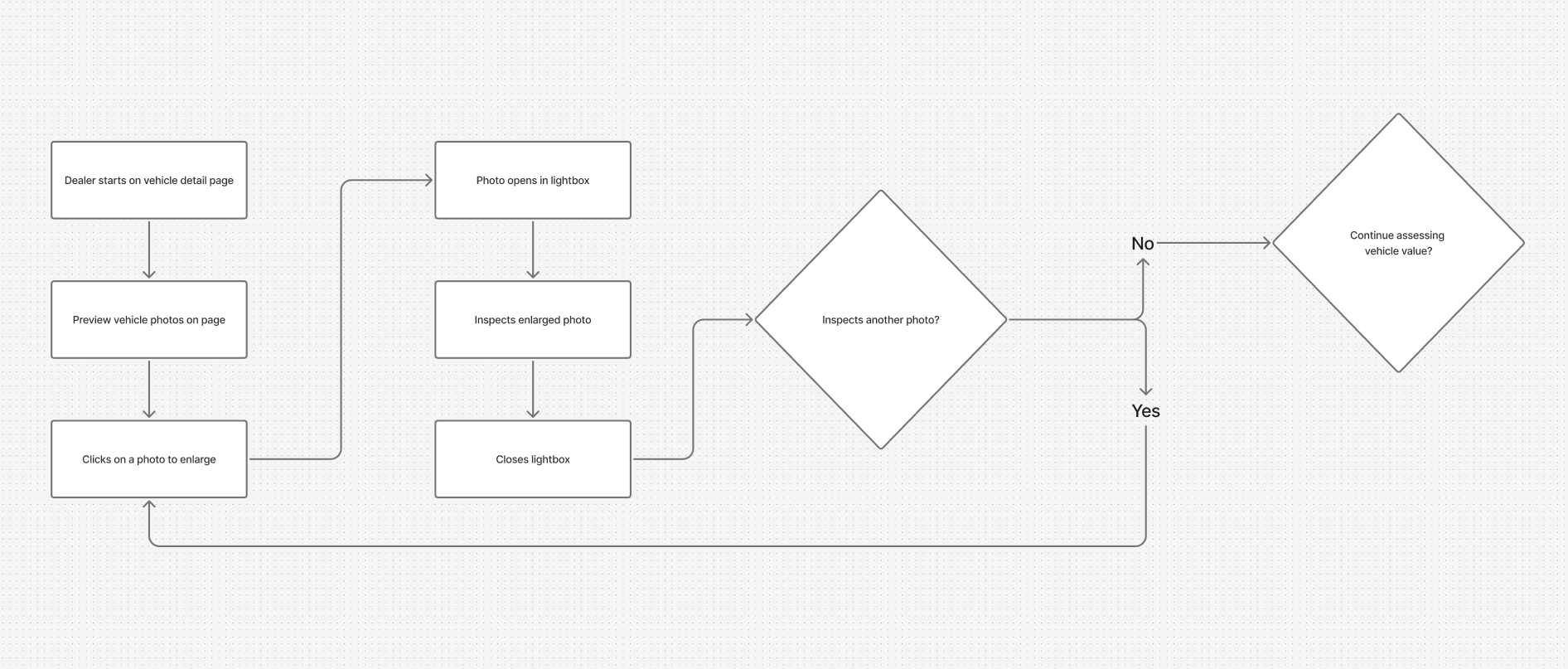
Old flow: the dealer starts on the vehicle detail page, previews photos, clicks a photo to enlarge it, the photo opens in a lightbox, they inspect it and close the lightbox. If they want to inspect another photo, they loop back to clicking a photo; if not, they continue assessing the vehicle's value.
Old flow: every photo check meant leaving the gallery and coming back.

03 · My role

What I owned, and who I had to bring along.

I owned

  • Framing the problem space
  • Running and synthesizing research
  • Defining the solution direction
  • The interaction model and UI, refined with engineering through implementation

I influenced

  • Keeping the expand photo button, so we could track engagement after release and validate the design

04 · Constraints and success criteria

What we couldn’t change, and what we agreed to move.

Constraints

  • Delivery within a roughly six-month window
  • Existing gallery infrastructure limited how much could be rebuilt
  • Changes couldn’t disrupt behaviors dealers already relied on

Success criteria

  • Pre-auction engagement: vehicles saved and notes created
  • Dealer confidence in photo quality and likelihood to bid
  • Time spent evaluating each vehicle

05 · Key decisions

Three calls that shaped the outcome.

  1. 1

    Restructure the existing gallery instead of rebuilding it

    Why this one

    It fit the six-month window and the existing gallery infrastructure without disrupting behaviors dealers relied on.

    What we gave up

    A deeper restructure of the gallery model.

  2. 2

    Show thumbnails when a dealer selects a photo group

    Why this one

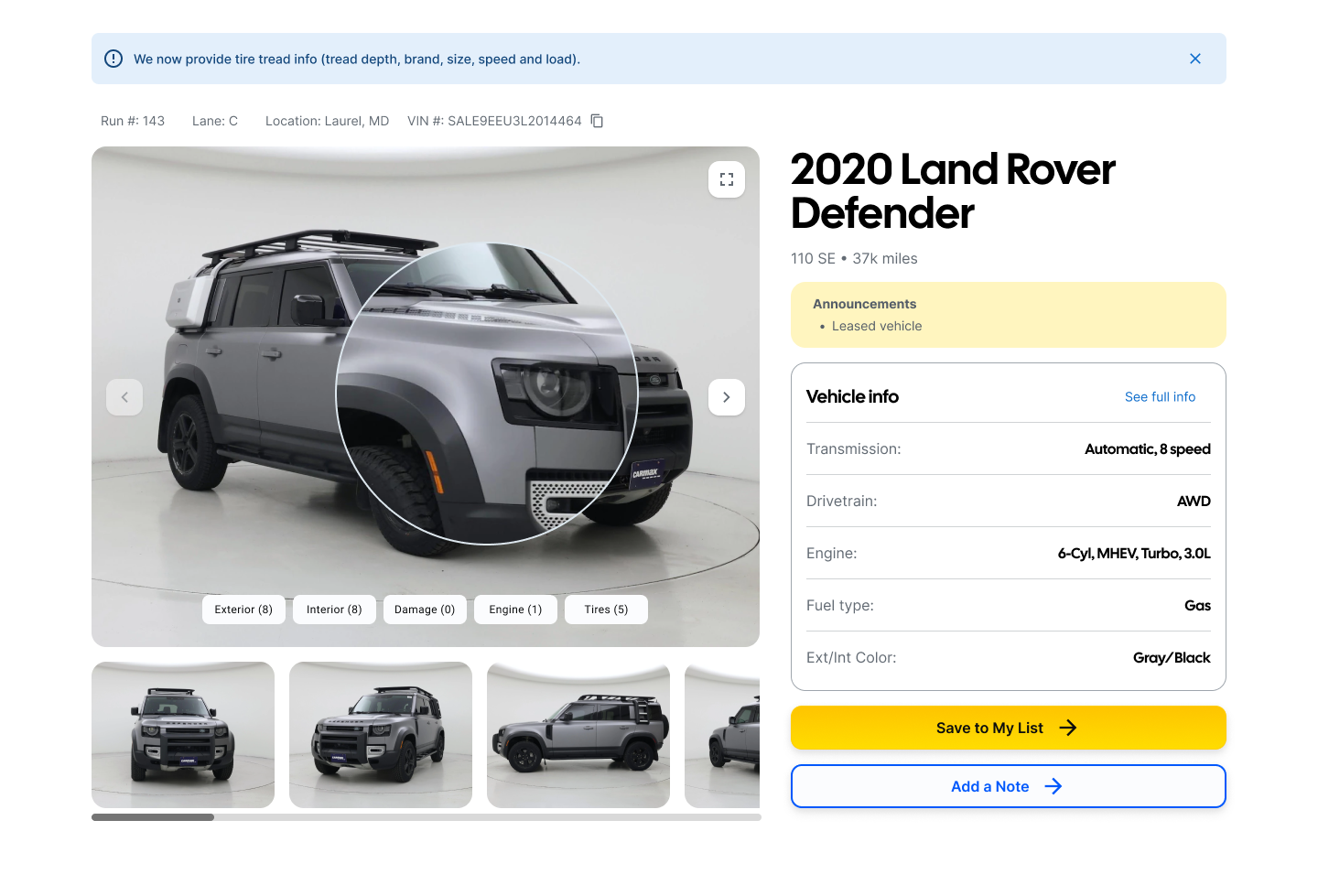
    It replaced 15–20 sequential clicks with a direct view of the whole group, so dealers jump straight to the photo they need.

    What we gave up

    Some image load speed.

  3. 3

    Add zoom on hover, against a mobile-first design methodology

    Why this one

    73% of Auctions dealers use desktop, so desktop got priority for close damage inspection.

    What we gave up

    Strict mobile-first parity. Mobile and tablet users kept close inspection through touch gestures.

06 · The solution

Before and after, tied to each decision.
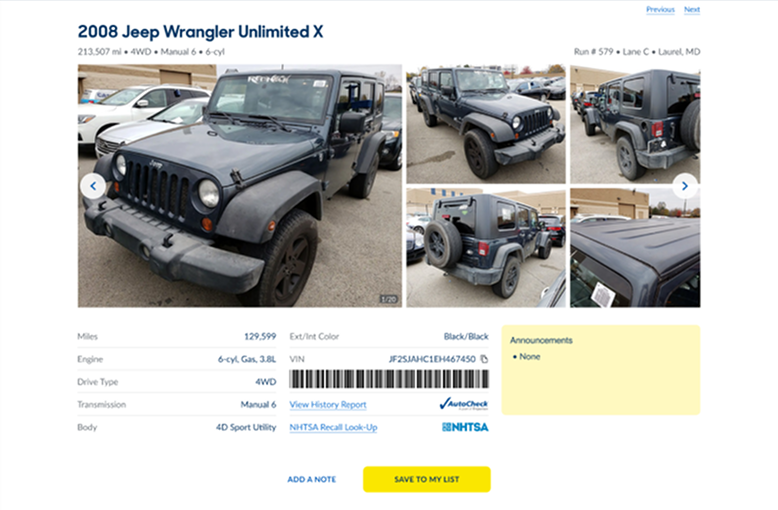
Before: the old vehicle detail page for a 2008 Jeep Wrangler Unlimited X, with one large photo, a grid of four smaller photos and arrow buttons for moving through the gallery one photo at a time.
Before
After: the redesigned vehicle detail page for a 2020 Land Rover Defender, with photo group tabs for Exterior, Interior, Damage, Engine and Tires, a circular zoom lens on hover over the main photo, and a scrollable thumbnail row.
After: thumbnails per photo group and zoom on hover
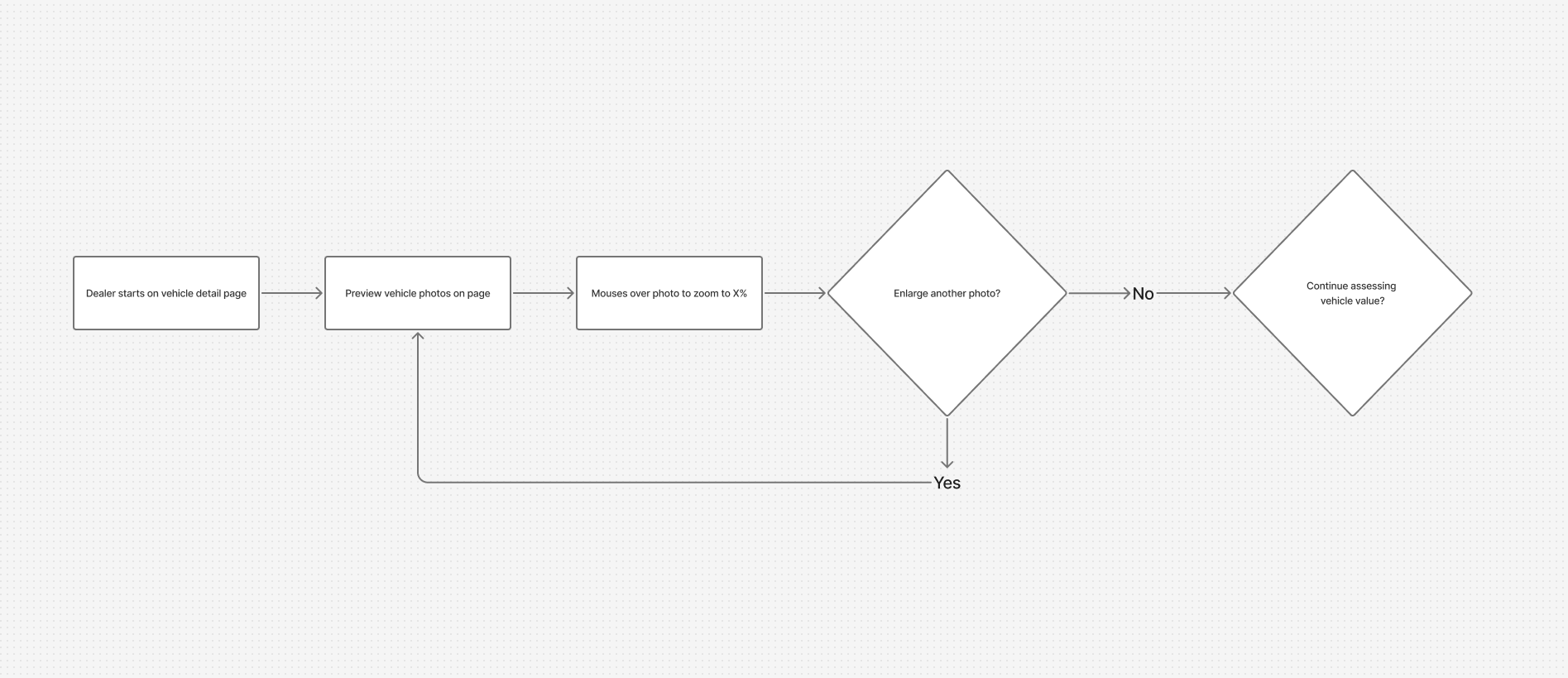
New flow: the dealer starts on the vehicle detail page, previews photos on the page and mouses over a photo to zoom in. If they want to enlarge another photo, they go back to previewing; if not, they continue assessing the vehicle's value.
New flow: dealers inspect damage without leaving their place in the gallery.

07 · Validation

How we knew it worked before it shipped.

  • Usability testing

    Tested the redesign with 3–5 dealers. It confirmed they could preview vehicle photos faster.

  • What changed

    Dealers asked to keep the arrow buttons, so we kept them alongside thumbnails and zoom.

  • Launch approach

    Phased rollout to 200 dealers to reduce risk and test system performance.

08 · Outcomes

What moved, measured against what.

Metric Result Baseline Measured with
Pre-auction engagement (vehicles saved, notes created) +16% Same-length period before launch FullStory, over a few weeks after launch
Dealer confidence in photo quality and likelihood to bid +25% Survey before launch Same survey after launch; 53 respondents completed both
Time per vehicle, average dealers 50% less [ADD BASELINE] [ADD SOURCE]

What I learned. Dealers didn’t need fewer photos. They needed to inspect damage without losing their place.

Have a problem like this? I’m open to senior product design roles. Reach out by email or LinkedIn.
Email me
Next case study Draft Annotations Putting the why inside the draft, so Google’s support routing admins can see the reason behind a change.
All work

CarMax Auctions · B2B workflow

Vehicle Preview Enhancements

Restructuring how dealers move through vehicle photos, so inspecting damage stops interrupting the evaluation it exists to support.

Role
Senior Product Designer, Design Lead, UX Researcher
Team
1 PM, 3 Engineers
Timeline
About 6 months, 2024
Platform
Desktop web, dealer actions tooling
The redesigned CarMax Auctions vehicle preview page on a desktop monitor, showing a 2020 Land Rover Defender with photo group tabs and thumbnails

The short version

Problem

Dealers clicked through 15 to 20 photos in a row and repeatedly opened and closed an enlarged view to check one vehicle for damage.

What I did

Led research, reframed the problem around keeping dealers in place during inspection, and redesigned the preview so thumbnails and zoom on hover replace the open, close and resume loop.

Result

Measurable lifts in engagement, dealer confidence and time spent per vehicle.

  • +16%Pre-auction engagement: more vehicles saved and more notes created before auction day
  • +25%Dealer confidence in photo quality and likelihood to bid, via dealer survey
  • 50%Less time per vehicle for average dealers

01 · Context

Vehicle preview is where a dealer decides to bid.

CarMax Auctions is CarMax’s wholesale business, where licensed dealers browse and evaluate inventory before bidding. The preview page is where most of that evaluation happens, especially for exterior condition and damage.

Business stakes
20,000–25,000 active dealers and 10,300+ auction vehicles listed per week.
User stakes
Dealers risk losing $1,500–$5,000 per vehicle when it’s assessed incorrectly.

02 · The problem

Dealers didn’t need fewer photos. They needed to inspect damage without losing their place.

  • 15–20Consecutive clicks through one gallery
  • Open, close, repeatThe enlarged-view loop for every check
  • 1–2 vs 4–8 minPer vehicle, power users vs everyone else
  • Both groupsSame friction: structural, not a skill gap
Old flow: every photo check meant leaving the gallery and coming back. Tap the diagram to open it full screen and zoom in.

03 · My role

What I owned, and who I had to bring along.

I owned

  • Framing the problem space
  • Running and synthesizing research
  • Defining the solution direction
  • The interaction model and UI, refined with engineering through implementation

I influenced

  • Keeping the expand photo button, so we could track engagement after release and validate the design

04 · Constraints and success criteria

What we couldn’t change, and what we agreed to move.

Constraints

  • Delivery within a roughly six-month window
  • Existing gallery infrastructure limited how much could be rebuilt
  • Changes couldn’t disrupt behaviors dealers already relied on

Success criteria

  • Pre-auction engagement: vehicles saved and notes created
  • Dealer confidence in photo quality and likelihood to bid
  • Time spent evaluating each vehicle

05 · Key decisions

Three calls that shaped the outcome.

  1. 1

    Restructure the existing gallery instead of rebuilding it

    Why this one

    It fit the six-month window and the existing gallery infrastructure without disrupting behaviors dealers relied on.

    What we gave up

    A deeper restructure of the gallery model.

  2. 2

    Show thumbnails when a dealer selects a photo group

    Why this one

    It replaced 15–20 sequential clicks with a direct view of the whole group.

    What we gave up

    Some image load speed.

  3. 3

    Add zoom on hover, against a mobile-first design methodology

    Why this one

    73% of Auctions dealers use desktop, so desktop got priority for close damage inspection.

    What we gave up

    Strict mobile-first parity. Mobile and tablet users kept close inspection through touch gestures.

06 · The solution

Before and after, tied to each decision.
Before
After: thumbnails per photo group and zoom on hover
New flow: dealers inspect damage without leaving their place in the gallery.

07 · Validation

How we knew it worked before it shipped.

  • Usability testing

    Tested the redesign with 3–5 dealers. It confirmed they could preview vehicle photos faster.

  • What changed

    Dealers asked to keep the arrow buttons, so we kept them alongside thumbnails and zoom.

  • Launch approach

    Phased rollout to 200 dealers to reduce risk and test system performance.

08 · Outcomes

What moved, measured against what.

  • +16%Pre-auction engagementVehicles saved and notes created, compared with the same-length period before launch. Measured in FullStory over a few weeks after launch.
  • +25%Dealer confidenceSurvey run before and after launch; 53 respondents completed both.
  • 50% lessTime per vehicleFor average dealers. [ADD BASELINE AND SOURCE]

What I learned. Dealers didn’t need fewer photos. They needed to inspect damage without losing their place.
Have a problem like this? I’m open to senior product design roles. Reach out by email or LinkedIn.
Email me
Next case study Draft Annotations Putting the why inside the draft for Google’s support routing admins.